
Clean Architecture
Clean architecture is a software design philosophy that separates the elements of a design into ring levels. An important goal of clean architecture is to provide developers with a way to organize code in such a way that it encapsulates the business logic but keeps it separate from the delivery mechanism.
Planning
Designing
Developing
Clean Architecture
Clean architecture is a software design philosophy that separates the elements of a design into ring levels. An important goal of clean architecture is to provide developers with a way to organize code in such a way that it encapsulates the business logic but keeps it separate from the delivery mechanism.
The main rule of clean architecture is that code dependencies can only move from the outer levels inward. Code on the inner layers can have no knowledge of functions on the outer layers. The variables, functions and classes (any entities) that exist in the outer layers can not be mentioned in the more inward levels. It is recommended that data formats also stay separate between levels.
Clean architecture was created by Robert C. Martin and promoted on his blog, Uncle Bob. Like other software design philosophies, clean architecture attempts to provide a cost-effective methodology that makes it easier to develop quality code that will perform better, is easier to change and has fewer dependencies.
Visually, the levels of clean architecture are organized into an unspecified number of rings. The outer levels of the rings are lower level mechanisms and the inner, higher levels contain policies and Entities.
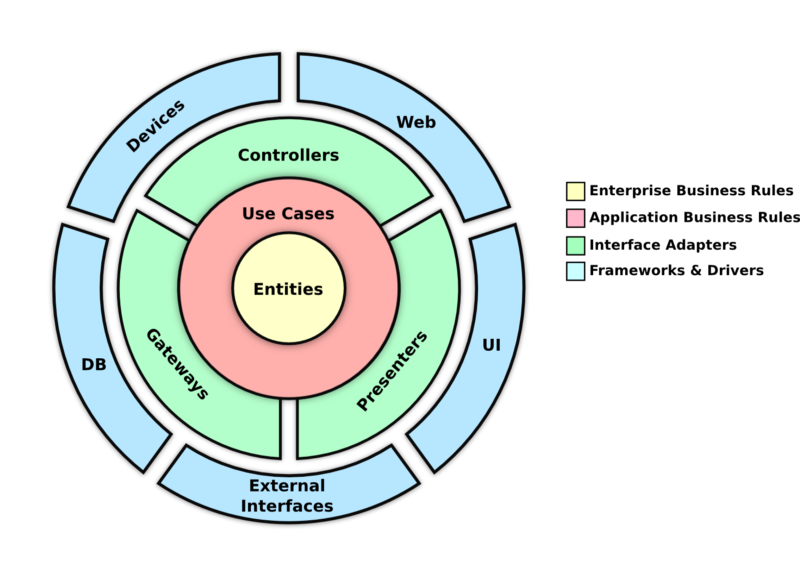
Benefits of Clean Architecture
Applying Clean Architecture to existing projects helps to ensure that the code remains maintainable and extensible over time by separating concerns. This means that different parts of the code are kept distinct and are only concerned with a single responsibility. This helps to make the code easier to maintain and test, as each component is focused on a specific task. Additionally, it helps to ensure that different parts of the code are loosely coupled and can be changed or replaced without affecting the other parts of the code.
Clean Architecture enhances maintainability, which refers to the ease with which a software system can be modified or updated. Clean Architecture encourages the use of design patterns, dependency injection, and inversion of control to ensure that the code is organized in a way that is easy to maintain. This helps to reduce the cost of software maintenance and makes it easier to add new features or make changes to existing ones.
Clean Architecture also facilitates modularity, which refers to the ability of a software system to be broken down into smaller parts that can be reused or exchanged with other parts. This makes it easier to change the underlying technology without having to rewrite the entire application. For example, in .NET Core, you can use dependency injection and inversion of control to decouple the code from the underlying framework. This allows you to easily switch from one technology to another, such as from .NET Framework to .NET Core, without having to rewrite the entire application.
Clean Architecture helps with testability, which refers to the ability of a software system to be tested in isolation. Clean Architecture encourages the use of design patterns and dependency injection to ensure that components are decoupled from the underlying framework. This makes it easier to write unit tests that focus on the business logic, rather than on the technical details of the framework. Additionally, it makes it easier to refactor code without breaking existing tests.
By creating clean, modularized code that is easier to modify and optimize, developers can ensure that their applications run faster and more efficiently. Additionally, the use of Clean Architecture can help to ensure that software remains extensible, allowing developers to quickly and easily add new features and functionality.
Challenges of Clean Architecture
The primary challenge when using Clean Architecture is ensuring that the code is properly separated into distinct components. Developers need to be careful to ensure that the code is properly organized and that each component is responsible for a single, distinct concern. This can be difficult, as it requires a deep understanding of the application and the components involved.
Another challenge when using Clean Architecture is that it can be difficult to apply the principles to existing software projects. This can be especially difficult if the project is large and complex, as it requires significant restructuring of the codebase. Additionally, existing code may need to be rewritten in order to conform to the principles of Clean Architecture.
In conclusion, Clean Architecture is a powerful tool that can help developers to simplify complex code, improve the performance of an application, and ensure that software remains extensible. While there are challenges associated with implementing Clean Architecture, the benefits are clear and can help to reduce development time and cost, as well as ensure that the code is maintainable and extensible over time.